
home
arrow

Revolutionizing surgical navigation with Atlas Medical Technologies and Kinova

Enhances precision and reduces cognitive workload for surgeons

7⁰ of Freedom

for full procedure area coverage

↑↑↑

Procedure efficiency

and consistency

"The Kinova arm proved to be the ideal match for our navigation system. With its slim, lightweight design and 7 Degrees of Freedom, which provide exceptional flexibility to cover the entire procedure area."
 
Wolfgang Urbild, VP Sales & Marketing at Atlas Medical Technologies GmbH

The Challenge


Atlas Medical Technologies’ journey began with the Amido 3D system, an early iteration of navigation robotics designed for medical interventions. Mounted on the ceiling and flipped down in front of the CT scanner, the system featured a laser robot moving along an arc around the patient. However, the ceiling-mounted design posed significant obstacles, particularly during demonstrations and customer engagement. Surgical navigation systems were limited to assisting surgical interventions in virtual space
The Solution


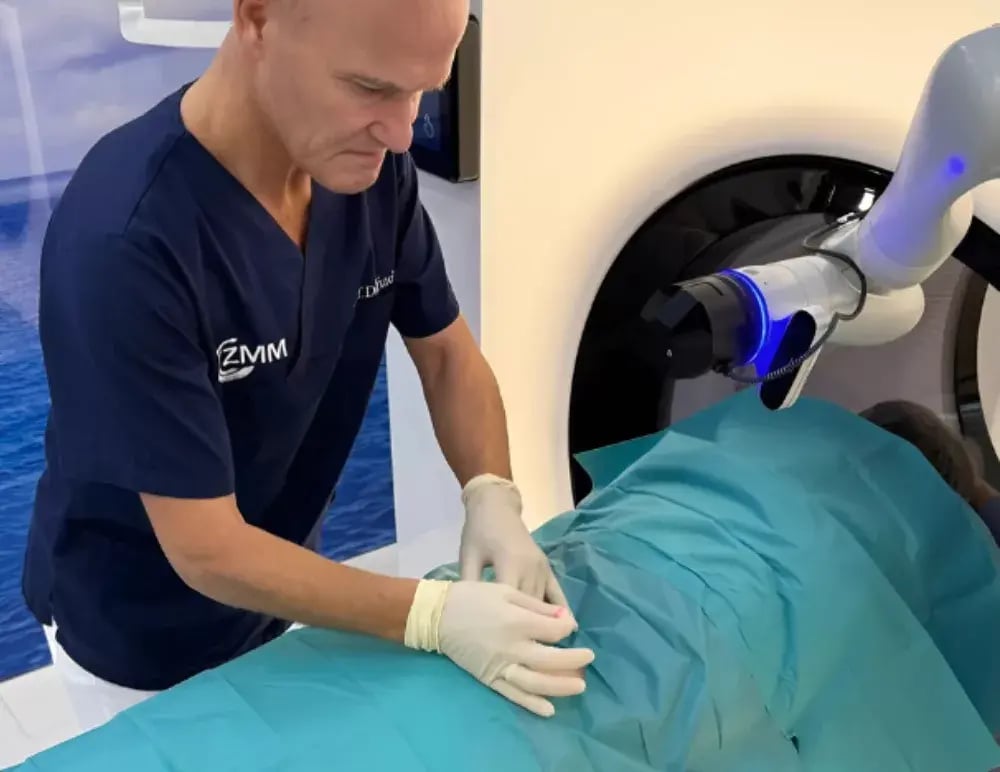
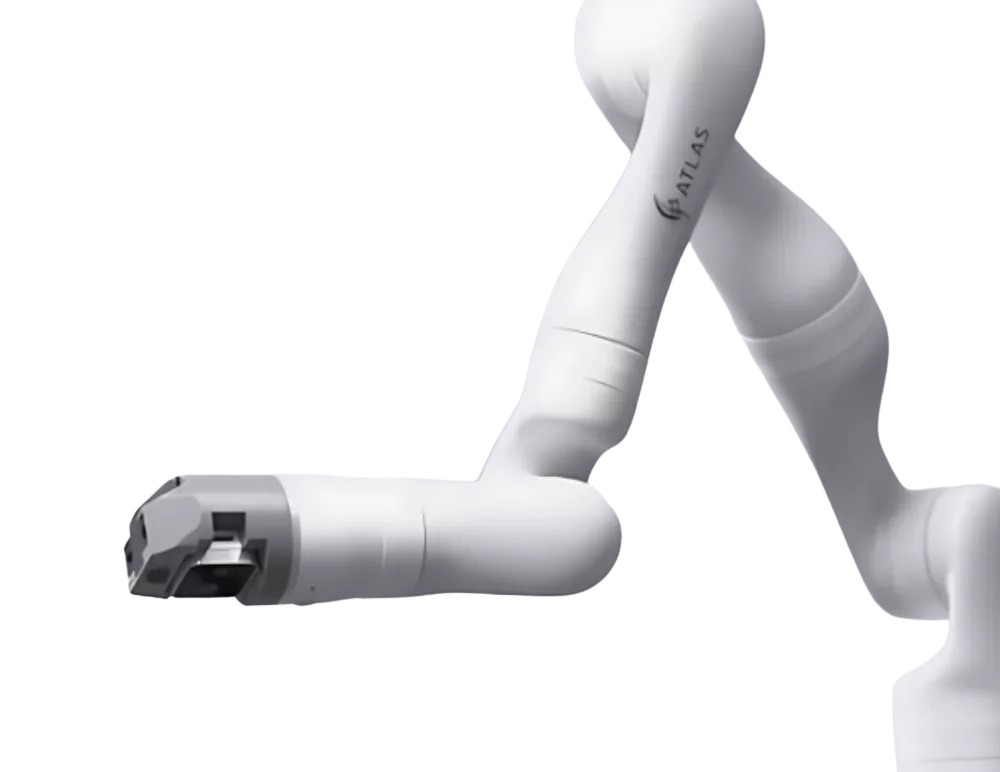
Recognizing the need for a more versatile solution, Atlas reimagined the navigation concept, creating a mobile and more flexible solution called the Atlas-4D system. This new iteration moved the navigation system onto a rolling stand, allowing for easy mobility and positioning in front of the CT scanner. More recently, Atlas introduced the Laser Robot Arm (LRA), integrating the Kinova Gen3 robot arm. The Kinova Gen3 was selected to mount a camera and laser at the robotic arm's head. The LRA system is connected to both the CT-scan and a computer, offering real-time patient tracking and trajectory guidance. Using a tracker mounted on the patient's back, the system precisely maps the patient's position. Physicians can then steer the robot via a tablet to mark injection sites, target masses, and define trajectories, including the insertion depth for needles. This system is the first to extend guidance into physical space, providing a real-time visual guide for entry points, insertion angles, and needle depth.

KEY FEATURES

Versatile and flexible:


The robotic arm’s mobility covers the entire
patient length, from neck to hip, allowing for a broader range of procedures

Slim and lightweight design


Ergonomic build


RESULTS


The integration of the Kinova arm has set a new benchmark in precision and efficiency. The LRA system is pioneering the transfer of trajectory planning directly onto the patient, offering a real-time visual guide that indicates the entry point, insertion angle, and required needle depth. This breakthrough enhances precision and reduces cognitive workload for surgeons. The system’s user-friendly nature and intuitive setup significantly reduce procedure time. Its mobility allows it to cover the patient from neck to hip, making it adaptable for various medical interventions. Furthermore, the Kinova Gen3 arm’s slim build minimizes the space used in crowded intervention rooms, and its mobile design allows it to be easily shared across multiple procedure rooms, enhancing clinical efficiency and flexibility.

Enhances precision and reduces cognitive workload for surgeons
Quick and intuitive setup significantly reducing procedure time
Minimized space usage in crowded intervention rooms
The Laser Robot Arm (LRA) is integrated with the Kinova Gen3 robotic arm

The Laser Robot Arm (LRA) is integrated with the Kinova Gen3 robotic arm to support a camera and laser mounted at the end effector

Showcase how you achieved real results

Submit My Success Story
No Case Study Yet?