
home
arrow

Ontario Power Generation Maximizes Safety and Efficiency with Robotic Inspections

Eliminating human exposure to high-radiation doses and hazardous underwater conditions

↑↑↑

Safety compliance with

zero human radiological uptake


↓↓↓

Unit downtime

↓↓↓

Complex "lockout/tagout" procedures

for human safety

“The benefits of using the ROV versus using an actual diver in the water are numerous. Number one is the radiological uptake... with the ROV we're not too concerned about it getting contaminated.”
 
Che Swearengen, Commercial Inspection and Maintenance Diver

The Challenge


Ontario Power Generation faced unique safety and logistical challenges across three specific infrastructure scenarios:


Scenario 1 - Injection Water Service Tank Inspection: These large underground tanks house heavy water used for nuclear injection and contain radioactive particles. The primary problems were the radiological dose involved (high risk of human contamination) and a hazardous leaking valve at the bottom of the tank that was passing water and could not be shut off, creating a dangerous suction hazard for human divers.


Scenario 2 - End Shield Inspection (Pickering Unit 6): A known leak existed on a calandria (reactor core housing fuel bundles), but there was no physical access for a human to perform an inspection. Furthermore, because fuel was still inside the core, the radiation dosage was extremely high, making the area completely unreachable for human divers.


Scenario 3 - Chats Falls Runner Inspection: routine inspections of submerged hydroelectric turbines, blades, and throat rings traditionally required a 6-person dive team. These operations were plagued by expensive and time-consuming lockout work protection procedures required to ensure the safety of human lives in the water.
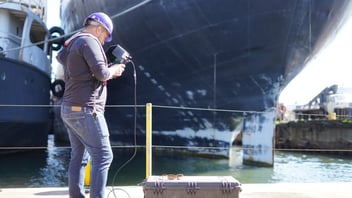
The Solution


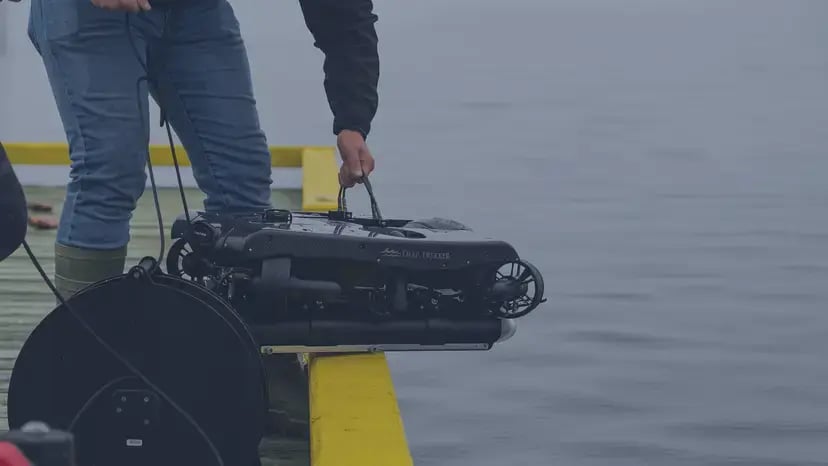
OPG implemented Deep Trekker ROVs to serve as the primary inspection tool in place of human divers for hazardous and restricted-access environments. In nuclear scenarios, the ROV was deployed into radioactive tanks and reactor cores while the systems remained in a "hold-op" or active state, avoiding the need for station owners to execute full system lockouts or pump shutdowns. For structural repairs, the team adapted the ROV's versatile frame to carry and deliver a sealant directly to the reactor duct.


In hydroelectric applications, the ROV replaced full dive teams for routine runner inspections. Because the ROV is a piece of equipment rather than a human, OPG was able to bypass the "human factor" safety protocols, allowing for faster deployment with a significantly smaller crew.

KEY FEATURES

Design Versatility:


The ROV’s design allows it to be adapted with custom attachments to "deliver a sealant" and perform repairs in addition to inspections.

Compact Maneuverability:


Small enough to access unreachable areas by going down around the core with the fuel bundles.

Radiation-Resistant Operation:


Capable of operating in environments with nuclear particles and high radiological doses

RESULTS


With the deployment of the ROV, OPG was able to resolve issues in the three mentioned-above scenarios:


Scenario 1 - Injection Water Service Tank Inspection: The ROV successfully completed all regulatory requirements for the underground tank inspection in just four hours. By utilizing the robot, the team was able to verify the status of a leaking valve that was "passing water," confirming its seal while the system was active and avoiding the high-suction hazard that would have endangered a diver. This method eliminated human radiological uptake entirely, as the equipment absorbed the contamination instead of personnel. Furthermore, because the inspection was conducted during a "hold-op" without requiring a full pump shutdown, OPG saved significant time by bypassing complex lockout/tagout procedures. The subsequent decontamination of the ROV was described as "very very minimal" compared to the intensive protocols required for a human diver.


Scenario 2 - End Shield Inspection (Pickering Unit 6): In the calandria of Pickering Unit 6, the ROV successfully located a leak in a high-radiation area that was previously deemed "unreachable for humans." This mission generated significant cost savings for the utility, as the robot's ability to operate in heavy water meant it was "unnecessary to shut the unit down, dewater and unfuel the unit." Beyond simple inspection, the team leveraged the vehicle's versatility to deliver and apply a sealant directly to the leak from the inside of the reactor duct. Despite the extreme conditions, the ROV was successfully decontaminated over a few months and returned to active service, proving the durability of the solution in nuclear environments.


Scenario 3 - Chats Falls Runner Inspection:  By replacing traditional dive operations with the ROV, OPG reduced the required workforce from a 6-person dive team to a 2-person crew. Because the ROV is a piece of equipment rather than a human, the expensive and time-consuming "work protection" and lockout procedures are no longer required. This shift has resulted in substantial cost savings while simultaneously increasing safety by keeping divers "safe and out of harm's way" during routine examinations of turbines, blades, and throat rings for cavitation or metal loss. The transition to robotic technology has now become the standardized methodology for all runner inspections at the Chats Falls facility.

0

Reduction in the number of personnel required for runner inspections

0
Required to thoroughly inspect an underground injection water service tank
Total elimination of human radiological uptake in high-radiation zones
Enhanced diver safety by avoiding high-suction valves and hazardous radiation.
Access to previously unreachable areas within the fueled reactor core 
Che Swearengen. Swearengen, Commercial Inspection and Maintenance Diver
“In this instance, costs and safety were the two driving factors. With regards to safety it was the human factor, there was no radiation and no work protection involved for shutting down the systems. Essentially we did this in a hold-op, we informed the station owners that we were going to be doing the inspection and they did not operate any pumps while we were in there. It saves quite a bit of time from trying to lock them all out and going through a lockout, tagout procedure. The other portion of that was the safety. This was a great tool to get in there and do inspection while maintaining cost and safety for everybody.”

Showcase how you achieved real results

Submit My Success Story
No Case Study Yet?