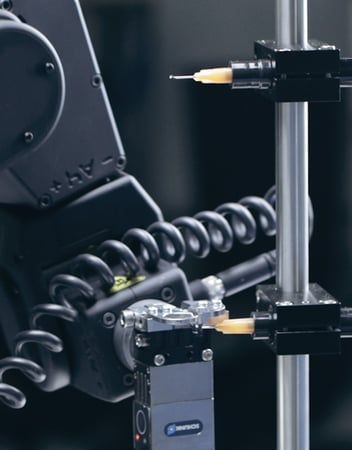
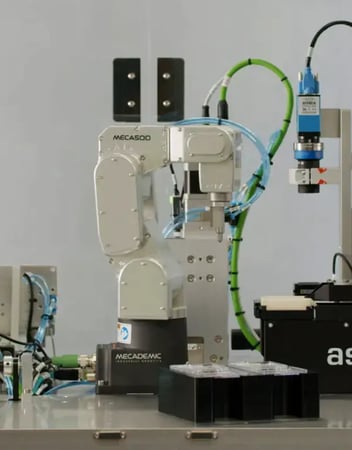
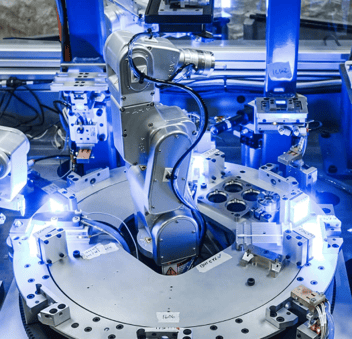
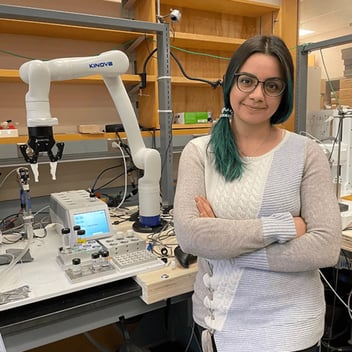
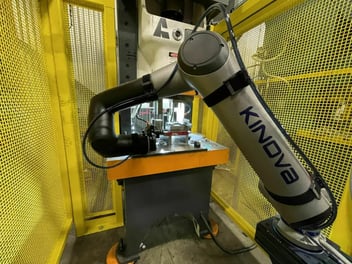
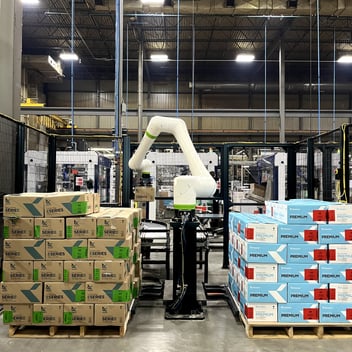
To achieve these goals, Dr. Chartrand decided to build an automation platform designed to streamline the fabrication process and enhance research throughput. For the robot component, Dr. Chartrand selected the world’s smallest six-axis robotic arm, the Meca500. Mounting the robot on a linear axis greatly enhanced its reach beyond what would have been possibly gained from using a larger robot. The robot’s minute and reproducible positioning removed the need for an alignment system using vision or other means.
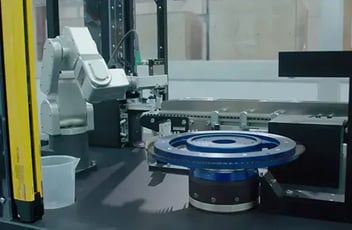
First, the robot places a rack on its base. Then, it transfers a glass substrate from the base to the spin-coater. Next, a liquid handler prepares and deposits liquids on the glass substrate, followed by a heating plate for annealing (heat treatment). Once a set time is reached, the robot removes the glass substrate from the plate, flips it, and deposits it in a tray, which, once full, is loaded by the robot into a vacuum chamber for metal deposition.