
home
arrow

US Navy Task Force Enhances Maritime Domain Awareness with Open Ocean Robotics’ DataXplorer™ USV

Offering a safer and more affordable solution for maritime surveillance, threat detection, dark vessel detection, and indefinite persistence in maritime domain awareness (MDA) operations. 

364 nmi
Total distance travelled
over 10 deployments 
80%

Success rate in identifying

the target vessel of interest

over the entire exercise

↑↑↑

Safety and affordability

maritime surveillance

and threat detection

 “Open Ocean Robotics demonstrated that unmanned systems can be successfully employed by the USCG, DoD, and other maritime entities to provide useful maritime domain awareness to its commanders.”


Defense Innovation Unit, Success Memo 

The Challenge

In 2022, Open Ocean Robotics uncrewed surface vehicle (USV) DataXplorer™ participated in the US Navy Task Force 59’s Digital Horizon exercise, which aimed to demonstrate the capabilities of mature uncrewed systems and data integration platforms for maritime domain awareness (MDA). The mission objectives required operating DataXplorer™ autonomously for all deployments—including during periods of poor environmental conditions, reduced optical visibility, and a degraded primary communications environment—while integrating and operating over radio communications alongside other uncrewed systems as a heterogeneous team, and detecting and identifying vessels of interest, particularly those that do not emit an Automatic Identification System (AIS) signal. 

The Solution


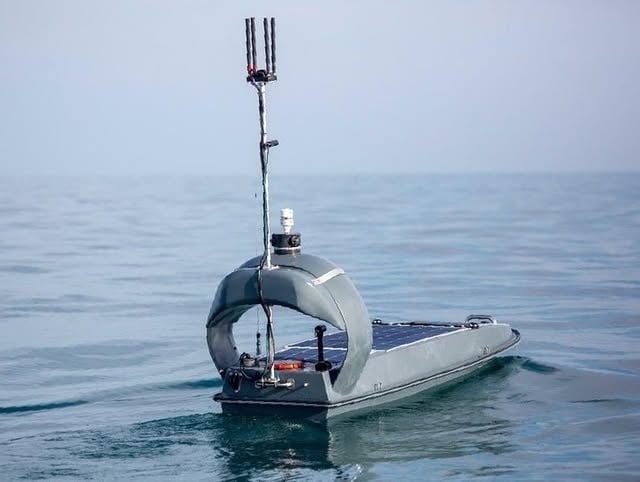
Equipped with a non-ITAR, forward-facing thermal camera and connected to a mesh network via radio communications, Open Ocean Robotics’ uncrewed surface vehicle (USV) DataXplorer™ completed 10 deployments during the Digital Horizon 2022 exercise to showcase its ability to detect and identify dark vessels. Open Ocean Robotics successfully integrated a SILVUS SC4400 onboard DataXplorer™, allowing telemetry to stream via radio communications and enabling DataXplorer™ to operate over the SILVUS mesh network alongside several other uncrewed vehicles (UxVs). Additionally, Open Ocean Robotics’ API was successfully integrated onto external platforms, allowing external users to stream visual data and control DataXplorer™ outside of XplorerView™.


DataXplorer’s self-righting rollbar system ensured reliable operation in high sea states by automatically righting itself if overturned, eliminating the need to retrieve or bring the USV to shore during severe weather. Furthermore, DataXplorer's solar panels enable it to recharge at sea, allowing for extended deployments and endurance for long-term monitoring missions.

KEY FEATURES

Uncrewed surface vehicle (USV) DataXplorer™ with non-ITAR, forward-facing thermal camera
SILVUS SC4400 onboard radio communications for mesh network operation alongside other uncrewed vehicles (UxVs)
Open Ocean Robotics’ API integrated onto external platforms


Allowing external users to stream visual data and control DataXplorer™ outside of XplorerView™

Self-righting rollbar system


Automatically rights the USV if overturned in high sea states

Solar panels


Enabling recharging at sea for extended deployments and indefinite persistence

RESULTS


Over 10 deployments during the Digital Horizon 2022 exercise, DataXplorer™ travelled a total distance of 364 nmi and reached a maximum distance of ~22 nmi offshore. DataXplorer™ was ready for deployment within 10 minutes of receiving instructions to deploy for 100% of the exercise, and during operations in Sea State 4 with 2-meter swells and wind speeds exceeding 50 knots, DataXplorer maintained stable performance, continuing its patrol without issues.


Over the entire exercise, DataXplorer™ had an 80% success rate in identifying the target vessel of interest and identified multiple other AIS and non-AIS vessels, with Open Ocean Robotics operators quickly communicating the bearing, estimated distance, and position of the vessel to Task Force 59 for further investigation.


Demonstrating indefinite persistence, in one 24 hour period during IMX, DataXplorer travelled under its own motor power for 22 hours while its solar panels produced more energy than the USV consumed. DataXplorer returned from its 10 day mission with 40-50% battery capacity—enough for multiple additional days at sea. Open Ocean Robotics’ API was also successfully integrated onto external platforms, allowing external users to stream visual data and control DataXplorer™ outside of XplorerView™.

0

total distance travelled over 10 deployments 

0

maximum distance reached offshore 

0
success rate in identifying the target vessel of interest (plus multiple other AIS and non-AIS vessels) 
0

out of 24h of the day travelled under motor power while generating more power than consumed 

 Eliminated the need to retrieve or bring the USV to shore during severe weather via self-righting rollbar system 
Demonstrated heterogeneous team collaboration alongside other uncrewed vehicles (UxVs) over a SILVUS mesh network
Safer and more affordable solution for maritime surveillance and threat detection

Showcase how you achieved real results

Submit My Success Story
Get The Case Study Toolkit