
home
arrow

Autonomous IUU Fishing Enforcement and Environmental Monitoring Near Hawaii with Open Ocean Robotics’ DataXplorer™ USV

Providing a cost-effective, persistent, and autonomous solution for maritime enforcement that is scalable, improves functionality, significantly lowers costs, emissions and safety risks, and increases the quality of evidence gathered. 

25-day
Continuous mission
conducted nonstop
in challenging open
ocean conditions
Up to 30km

AIS detections

achieved with continuous

uninterrupted detections

↑↑↑

Reliability & seaworthiness for

continuous operations with

near real time comms

& detections, over the horizo

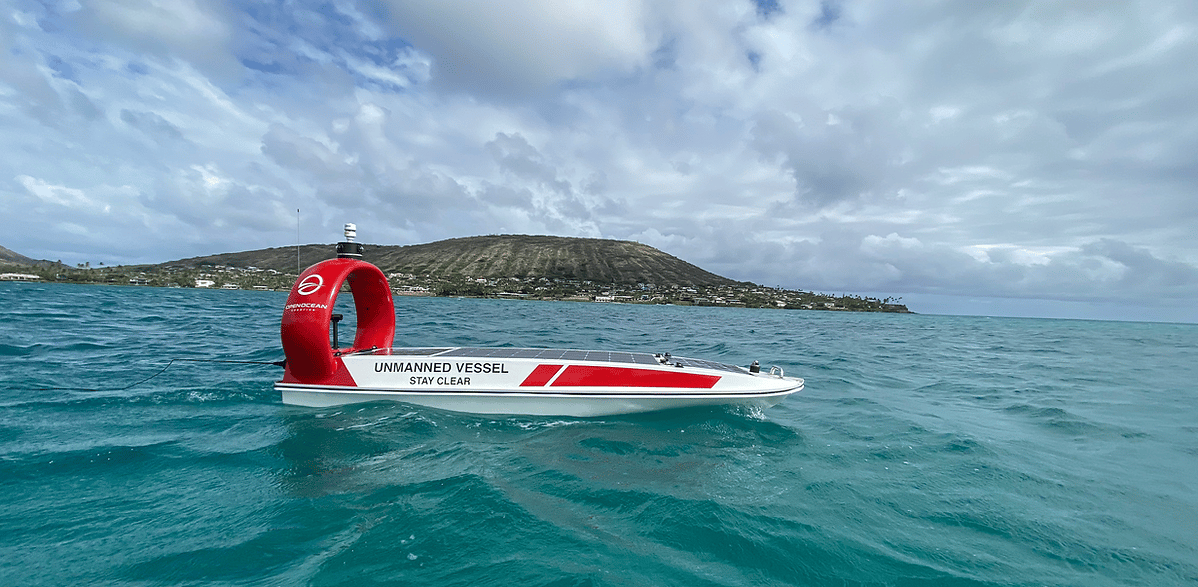
As part of WildAid’s MPAbots program, Open Ocean Robotics’ uncrewed surface vehicle (USV) DataXplorer™ conducted a nonstop 25-day mission in the Pacific Ocean near Hawaii to combat illegal, unregulated, and unreported (IUU) fishing. Piloted remotely from Victoria, BC, the USV operated continuously in challenging open ocean conditions with a suite of visual, thermal, acoustic, AIS, and oceanographic sensors—providing near real-time vessel detections up to 30 km, preventing AIS spoofing, and collecting environmental data at significantly lower cost, emissions, and safety risk than traditional crewed surveillance assets.

WildAid Marine’s mission is to build the world’s most effective and well-enforced marine protected areas (MPAs) to safeguard critically-endangered marine species and ecosystems and promote sustainable development.

The Challenge

Traditional open ocean surveillance uses fixed assets on shore, satellites, crewed ships or aircrafts. These assets are expensive, polluting, lack resolution, and require significant resources and personnel, and developing nations can rarely afford these solutions. The project—part of WILDAID's MPAbots program, a multi-organization initiative to advance, validate, and demonstrate use of robotic technologies to combat illegal fishing—sought to operate USV DataXplorer™ continuously for 25 days in open ocean conditions, run a suite of sensors for vessel detection and environmental monitoring, and demonstrate how remotely collected data could aid counter IUU fishing by providing insights for interdiction, closer monitoring, or prosecution.

The Solution


Open Ocean Robotics deployed its uncrewed surface vehicle (USV) DataXplorer™ on a 25-day mission in illegal, unregulated, and unreported (IUU) fishing enforcement in the Pacific Ocean near Hawaii, utilizing small, mobile USV fleets that are scalable, improve functionality, significantly lower costs, emissions and safety risks, and increase the quality of evidence gathered. Piloted from Victoria BC, DataXplorer™ operated nonstop in challenging open ocean conditions, traveling preprogrammed missions that can be modified to change the route, sensor sampling rate, and more, while sending data in real-time to operators. Equipped with a suite of surveillance and oceanographic sensors—including 360 degree visual cameras, a thermal camera, AI driven edge computing, hydrophones, underwater cameras, and AIS detection—DataXplorer™ continuously monitored for detecting, identifying, and tracking vessels and associated fishing activity while collecting detailed ocean information to complement space data.

KEY FEATURES

Uncrewed surface vehicle (USV) DataXplorer™ capable of nonstop continuous operations in challenging open ocean conditions
360-degree visual cameras and thermal camera for day and nighttime surveillance
Continuous uninterrupted AIS detections at up to 30km to detect AIS and combat AIS spoofing
Hydrophones for acoustic signatures, underwater cameras, oceanographic sensors and weather sensors

RESULTS


DataXplorer™ successfully completed a 25-day continuous mission in the Pacific Ocean near Hawaii, operating nonstop in challenging open ocean conditions while persistently monitoring with its suite of sensors for detecting, identifying, and tracking vessels and associated fishing activity. For visual surveillance, the USV utilized 360 degree visual cameras and a thermal camera for day and nighttime surveillance alongside AI driven edge computing for automatic vessel detection and identification. For AIS detections, it achieved continuous uninterrupted detections at up to 30km, proving useful for detecting AIS and combatting AIS spoofing.  


Concurrently, DataXplorer™ performed continuous environmental monitoring using underwater cameras, oceanographic sensors (for temperature, turbidity, salinity, chlorophyll, and more), hydrophones, and weather sensors measuring air temperature, wind speed & direction, and barometric pressure. Piloted remotely from Victoria BC with data sent in real-time to operators, the USV demonstrated the ability to fuse space and USV data by collecting detailed ocean information to complement space data, identifying vessels without AIS, and validating AIS signatures to prevent spoofing. Overall, the deployment demonstrated reliable and seaworthy continuous operations, near real time comms and detections over the horizon, comprehensive vessel monitoring via images, acoustic signatures, and AIS detections, and an easy to use interface to operate the USV and share information with enforcement agencies. 

0

continuous mission completed nonstop in challenging open ocean conditions

0

continuous uninterrupted AIS detections

0
visual cameras and thermal camera for day and nighttime surveillance 
Significantly lowers costs, emissions, and safety risks while increasing the quality of evidence gathered 
Reliable and seaworthy for continuous operations with near real time comms and detections over the horizon
Identifies vessels without AIS and validates AIS signatures to prevent spoofing, complementing space/satellite data
Easy to use interface to operate USV and share information with enforcement agencies for interdiction, closer monitoring, or prosecution

Showcase how you achieved real results

Submit My Success Story
Get The Case Study Toolkit